Strategy
Retool Roadmap Priorities: Performance, Components & AI
If you've spent serious time building internal tools in Retool, you've probably hit a wall — maybe the table lags with large datasets, you wished for a drag-and-drop list component, or you found yourself writing more JavaScript glue code than actual business logic. A community thread titled "Future Priorities for Retool" captured exactly these frustrations, and what made it remarkable was that Retool's CEO jumped in to respond point by point. Here's a breakdown of the top Retool roadmap priorities the community and company aligned on — and what they mean for developers building on the platform today.
Why Performance Is Still Retool's Biggest Priority
The thread opened with a clear consensus: performance improvements come first. The introduction of Runtime V2 (Retool's new render engine) was widely praised as a meaningful step forward, but developers noted it hasn't fully bled into the IDE experience yet. The new Table component was called out specifically for its speed — but the ask was clear: keep it fast as new features are added, and bring the same treatment to ListView, which still suffers from sluggishness at scale.
Retool CEO David Hsu confirmed the focus: "Performance is critical. I'm glad we've made a lot of progress with Runtime V2, but there's more work to do." If you're building apps with large datasets or complex nested components, this is the most important signal from the roadmap discussion — performance is being actively invested in, not deprioritized.
New and Improved Components: What Developers Are Asking For
The second loudest request was for richer, more frequent component releases. The community wishlist included:
- Treeview — for hierarchical data navigation
- Drag List / Drag Grid — for reorderable interfaces
- Advanced charting and mapping — to close the gap with BI tools like Tableau
- Context menus — for right-click interactions
- More component events —
beforeUpdate,afterUpdate,onDblClick, and more - Password input for mobile — a seemingly small but frequently needed omission
The CEO acknowledged this area had been underinvested: "Improved and new components have not been a focus for us thus far, but maybe it should be. I agree it'd be great to ship a new component every week." The app-building team was flagged as the owner of this work. If you're waiting on a specific component, filing a feature request in the community forum is still the most direct path to getting it prioritized.
A Better Developer IDE Is Coming
Dark mode. Dockable windows. Multi-monitor support. A proper code editing experience. These aren't new requests — they've lived in the feature request forum for years. But this thread surfaced a concrete commitment: a significantly improved code editing experience was on track to ship within weeks of the discussion, with broader IDE improvements planned for the rest of the year.
For teams where Retool developers outnumber business users, IDE quality directly impacts productivity. If you're managing complex apps with dozens of queries and components, a better editing environment isn't a nice-to-have — it's a daily friction cost.
Python Support and Reducing JavaScript Dependency
One of the most interesting threads within the thread was around JavaScript. A data-focused developer raised the idea of reducing or eliminating the need for JS — either by supporting SQL-based data manipulation everywhere or by adding Python as a scripting option. The response was nuanced:
- SQL for data manipulation is already partially supported via
Query JSON with SQL, which lets you JOIN results from different sources (Postgres, Stripe, BigTable, etc.) using standard SQL syntax — as long as the data is shaped as an array of objects. - Python in Workflows landed around the time of this thread, with a commitment to bring it to the web app builder soon.
If you're a data engineer or analyst building in Retool, the Query JSON with SQL feature is worth exploring right now — it's one of the most underutilized capabilities on the platform and can eliminate a significant amount of JavaScript transformation logic.
AI-Assisted Development: The Emerging Priority
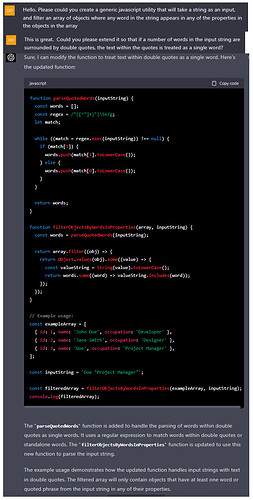
One community member made a compelling case for a native AI/Copilot integration inside Retool — and the timing couldn't be more relevant. The argument: since most Retool use cases are predictable (CRUD interfaces, API integrations, JSON parsing, table filtering), an AI assistant trained on Retool's component model and query patterns could dramatically lower the barrier for non-developers. Even without a native integration, developers in the thread were already using GPT-4 to generate JavaScript fragments — one described going from problem to working, reusable module in under 20 minutes.
A native AI layer inside Retool — aware of your component tree, query names, and data shapes — would be a meaningful leap. This isn't on the official roadmap yet, but it's clearly on the community's mind.
The Core Takeaway: Depth Over Breadth
Perhaps the most strategically important sentiment from the thread was this: put 80% of resources on the core product — quality over quantity. Retool has been expanding into Retool Workflows, Retool Database, and embedded use cases. These are valuable, but the developers building mission-critical internal tools every day want the foundation to be rock solid first.
If you're evaluating Retool for a new project or making a case internally for adopting it, the roadmap signal here is positive: the company is listening to its power users, and the CEO is engaged enough to respond in community threads. The platform is investing in the right things — performance, developer experience, and extensibility. The question is execution speed.
Want help architecting a Retool app that performs well today, without waiting for future improvements? That's exactly what we build.
Ready to build?
We scope, design, and ship your Retool app — fast.